Your professional jewellery valuation may one day be examined in court.
It doesn’t matter if you own a single treasured heirloom or run a jewellery business – a professional jewellery valuation is not just a piece of paper stating what something is worth. It’s an important document that has to be able to hold its ground.
Too many people assume valuations exist for one reason only: insurance. That’s part of it, yes, but it’s not the whole story.
A properly prepared jewellery valuation is a legal document.
It needs to be accurate, well-researched, and able to withstand real scrutiny, including, if it ever comes to that, scrutiny in a court of law. If you get it wrong, you’re not just looking at an awkward conversation with an insurer; you could be looking at disputes, financial loss, or legal issues.
I want to share something that happened to me early in my career, because it’s stuck with me ever since, and I think it explains why accuracy and record-keeping matter more than most people realise.
The Ring That Went to Court
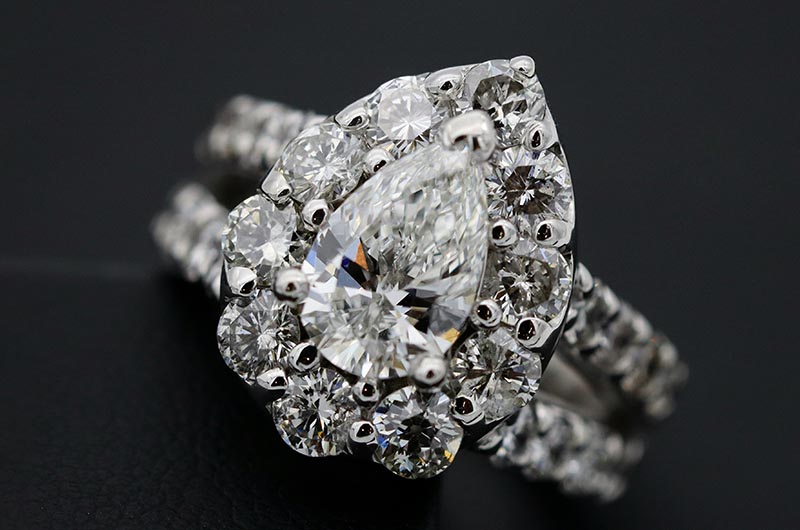
I was once called out to the home of a frail elderly lady to value her jewellery. Among the pieces was a diamond solitaire ring.
Years later, a diamond cutter took several of her items, including that same ring, to sell on her behalf. He sold the jewellery. He never paid her a cent. The matter ended up in court, and because I’d prepared the original valuation, I was called in as an expert witness.
By that point, years had passed since I’d valued the ring. The advocate zeroed in on one figure: my estimated diamond weight of 2.05 carats. The stone was mounted, so I’d never been able to weigh it directly. However, I had estimated it from careful measurements taken in the setting. Anyone in the trade knows that once a diamond crosses two carats, the value climbs sharply, so that number became the whole battle.
The questioning didn’t stop at the valuation itself. I was pressed on diamond cutting, proportions, angles, and how each of those factors into weight estimation. I’m not a diamond cutter, but understanding how cutting and proportion work meant I could answer every question with confidence. If I hadn’t known that side of things cold, cross-examination would have taken me apart.
At the lunch adjournment, the attorneys phoned the elderly lady, too frail to attend court herself, and asked her to dig out the original purchase paperwork. Against the odds, she found it: the original sales invoice.
It listed the diamond’s weight as exactly 2.05 carats.
My estimate was dead on. That moment proved something I already believed but had never seen confirmed quite so cleanly: when a round brilliant is well cut and well proportioned, careful measurement combined with the right formula can produce a genuinely accurate weight estimate, even with the stone still in its setting.
Two Lessons That Never Left Me
First, knowing how to fill in a valuation form isn’t enough.
You need a real, working understanding of gemstones, diamonds, grading, proportions, and valuation methodology, deep enough that you can defend your opinion under oath, in front of people whose job is to find the crack in it.
Second, keep your records.
We hold onto our valuation files for decades, because you never know when something you valued today ends up on a judge’s desk twenty years from now.
That court case wasn’t a one-off, either. On another occasion, I was flown out to the Kimberley High Court to give expert evidence on a parcel of stolen sugilite.
I like to think of a valuation as a witness statement.
You don’t write it hoping no one ever reads it closely. You write it as though someone eventually will, under oath, with a lawyer looking over your shoulder for the weak point. If it’s built properly, it holds. If it isn’t, it falls apart exactly when you need it most.
As a valuer, your report is not just a piece of paper. It’s a legal document.
Advocates, judges, and other experts may examine it one day, and when they do, you need to be able to explain every conclusion and every figure you put your name to.
If your valuation is accurate, your methodology sound, and your records complete, you have nothing to fear. That’s really the whole game.
What Goes Into a Proper Jewellery Valuation
This is exactly why proper training in gem identification, diamond grading, and jewellery valuation matters so much. It protects your clients, your reputation, and, in the end, you.
Producing a professional valuation takes a lot more than looking at a piece of jewellery and putting a number on it. The valuer needs the knowledge and experience to:
- Correctly identify gemstones
- Grade and value coloured gemstones using recognised grading principles
- Accurately grade and value diamonds
- Identify treatments that may affect value
- Detect and distinguish natural, laboratory-grown, and imitation stones using specialised gemmological equipment, and just as importantly, know how to correctly interpret what that equipment tells you
- Assess precious metals, craftsmanship, condition, and replacement cost
Modern technology has made gemstone identification harder than it used to be, not easier. Laboratory-grown diamonds and lab-grown gemstones continue to improve, which makes advanced testing equipment essential. But the equipment is only half of it.
A machine will hand you a reading. It won’t hand you the right conclusion.
That still comes down to the knowledge and experience of the person interpreting the result.
Our Approach at The Gem Lab
At The Gem Lab, we bring together decades of hands-on gemmological experience with advanced testing equipment to produce valuations that are independent, accurate, and properly prepared. Every valuation gets the same level of care, regardless of whether it’s needed for insurance, probate, resale, auction, estate planning, or legal documentation.
It doesn’t matter if you’re in the trade or you simply own jewellery that means something to you. Having your valuation prepared by someone qualified and experienced is one of the most important steps you can take to protect it.
If your jewellery hasn’t been professionally valued in the last few years, or you’d simply like an independent assessment, we’d be glad to help.
Contact The Gem Lab at info@gemlab.co.za to discuss your valuation requirements.
Jeremy